
What ADHD Testing Actually Includes for Adults
- Ryan Burns

- Apr 5
- 8 min read
Last reviewed: 04/05/2026
Reviewed by: Dr. Kiesa Kelly
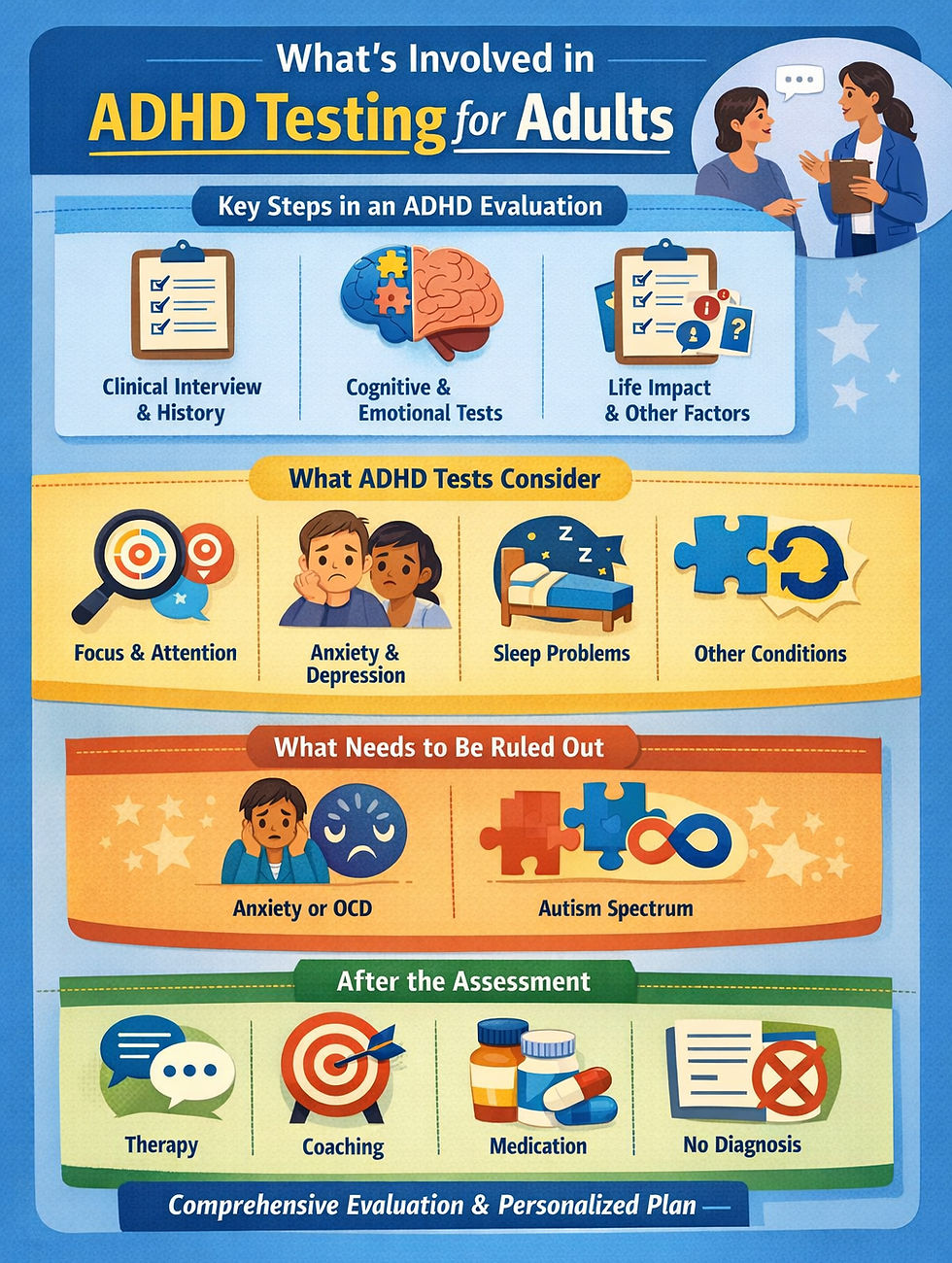
If you are searching for ADHD testing, you may be picturing one test, one score, and one clear yes-or-no answer. For adults, that usually is not how diagnosis works. A strong assessment is a clinical process that looks at patterns across time, real-life impairment, childhood history, and overlap with other conditions - not just whether a checklist feels familiar. [1,2]
In this article, you’ll learn:
what people usually mean when they search for ADHD testing
how a screener differs from a formal assessment
what an adult ADHD evaluation typically includes
why sleep, anxiety, trauma, OCD, and autism matter in the process
what should happen after the assessment, whether ADHD is diagnosed or not
What people mean when they search for ADHD testing
Most adults are not really looking for a single “adult ADHD test.” They are looking for clarity. They want to know whether ADHD fits, whether something else could explain the pattern, and what to do next if life has started to feel harder than it looks from the outside.
Online quiz vs formal assessment
An online quiz or screener can be a useful first step. If you have already tried an adult ADHD screener, that result can give you language for what you have been noticing and help you decide whether a fuller evaluation is worth pursuing. But a screener is designed to identify who may need more assessment; it is not the same thing as a diagnosis. [3]
You can think of screening as triage, not proof. The best use of a questionnaire is to start a better conversation. That is also why broader mental health screening tools can be helpful when the real question is bigger than attention alone.
Key takeaway: 🧭 A positive screener means “look more closely,” not “case closed.”
Screening, diagnosis, and treatment planning are not the same
This distinction matters because people often confuse three different steps. Screening asks whether ADHD might be present. Diagnosis asks whether the full pattern meets criteria and causes meaningful impairment across settings. Treatment planning asks what support would actually help, which may include therapy, coaching, medication referral, accommodations, or a different treatment path altogether. [1,2]
For example, someone might have a positive screener because they are exhausted, sleeping poorly, and barely holding work together. Another person might have the same screener result because they have had lifelong problems with organization, time blindness, and follow-through that started in childhood. Those are not the same clinical question, even if they look similar on the surface.
What an adult ADHD assessment usually includes
A good process is broader than paperwork and more precise than “you seem distractible.” If you are reviewing options for psychological assessments, it helps to know what should be in scope before you book.
Clinical interview and symptom history
The clinical interview is usually the center of the process. That means talking through your current symptoms, how long the pattern has been present, how it has shown up at school, work, home, and in relationships, and whether there is evidence that it began in childhood. Good assessment also includes developmental and psychiatric history, mental-state review, and examples from everyday life rather than vague agreement with symptom words. [1,2]
This is where a lot of adults feel surprisingly seen. A careful evaluator will often ask not only what you accomplished, but how you got there. Good grades, a graduate degree, or a successful career do not automatically rule ADHD out if the process relied on panic, all-nighters, intense overcompensation, or constant self-monitoring.
One common misconception is that childhood ADHD would have been obvious. In reality, many adults - especially high-masking adults, women, and people with strong verbal ability or external structure - were missed earlier and only start asking questions when life becomes less scaffolded. [1]
Key takeaway: 🧠 In adult assessment, the story behind your performance often matters as much as the performance itself.
Functional impact, sleep, anxiety, trauma, and overlap factors
Diagnosis is not just about recognizing traits. It is about whether the pattern creates clinically meaningful difficulty in real life. Good evaluation looks at deadlines, money management, household follow-through, driving, emotional regulation, relationship strain, and the effort it takes to stay afloat. NICE guidance specifically emphasizes impairment across multiple important settings and consideration of coexisting conditions and physical health. [1]
This is also the point where differential diagnosis matters. Sleep disruption can worsen or imitate attention problems, and sleep difficulties are common enough in adults with ADHD that they should be screened during the clinical interview. [5] Anxiety can narrow attention and increase restlessness; trauma can affect concentration, arousal, and memory; and OCD can create a very different kind of “stuckness” that can be mistaken for procrastination or indecision if no one asks the right questions. [1,4,7]
That does not mean these factors make ADHD less real. It means a strong evaluator is trying to understand what is primary, what is overlapping, and what needs its own treatment plan. In our practice, that is one reason we screen for common look-alikes and co-occurring concerns such as anxiety, learning differences, sensory differences, and burnout rather than stopping at a quick label. [8]
If sleep problems are part of the picture, our insomnia care page may help you think through that piece separately. If obsessions, compulsions, or mental rituals are muddying the picture, our OCD resources can help you compare patterns more clearly.
When rating scales are useful
Rating scales are useful when they are used as tools, not verdicts. A well-run adhd evaluation may include self-report measures, symptom checklists, and sometimes observer input to organize the clinical picture and track patterns more systematically. NICE is explicit that ADHD should not be diagnosed solely from rating scales or observational data, while also noting that rating scales can be helpful added tools. [1]
In other words, forms are there to support judgment, not replace it. If a service is mostly automated scoring, one short appointment, and no real effort to understand your history or functioning, that is a reason to slow down.
Key takeaway: 📋 Rating scales are most useful when they support a thoughtful interview and differential diagnosis.
What good ADHD testing should rule in and rule out
Burnout, anxiety, OCD, and sleep disruption
Good adult ADHD testing is not about talking you out of ADHD. It is about making sure the answer is sturdy enough to be useful. Symptoms of overwhelm, chronic stress, poor sleep, anxiety, trauma, and OCD can overlap with ADHD in ways that change both diagnosis and next steps. [1,4,5,7]
Burnout is a good example. It is not the same as ADHD, but sustained overload can produce forgetfulness, reduced initiation, poor concentration, emotional depletion, and inconsistent follow-through. A quality assessment asks whether the pattern is lifelong and cross-situational, whether it was present before the current stress load, and whether it improves when demands, sleep, or anxiety change.
Another misconception is that if the evaluator asks about anxiety, sleep, or OCD, they must not believe you. Usually the opposite is true. Careful differential work is one of the main signs that the process is taking your concerns seriously.
Key takeaway: 🔎 A thorough assessment does not narrow too early. It tests the fit of ADHD while also checking for patterns that can mimic it or travel alongside it.
Autism and AuDHD overlap
Autism and ADHD often overlap, and adults may use the community term “AuDHD” when both patterns seem relevant. Research in adult samples supports meaningful co-occurrence while also showing that autism and ADHD remain separable constructs rather than interchangeable labels. [6]
That distinction matters because recommendations may change depending on what is driving the difficulty. An adult whose main issue is attention shifting, time management, and task initiation may need different supports than an adult whose biggest challenges involve sensory load, social processing, predictability, and recovery after change - even though some surface struggles overlap.
A third misconception is that if autism is part of the question, the ADHD assessment somehow “does not count.” In reality, overlap is one of the reasons comprehensive assessment can be more useful than a quick, one-track evaluation.
What happens after the assessment
Therapy, coaching, medication referral, or no diagnosis
The most useful assessments end with guidance, not just a label. If ADHD fits, next steps may include psychoeducation, therapy, accommodations planning, executive function support, or referral to a prescriber if medication is something you want to explore. If ADHD does not fit, the process can still be valuable because it may clarify a more accurate explanation and a better treatment path. [1,2]
In our assessment work, you receive a written report and a feedback session. Recommendations are meant to be practical and strengths-based, including guidance for work or school accommodations when appropriate. [8]
Some adults also benefit from structured skill support after diagnosis or clarification. Our executive function coaching page explains what that kind of day-to-day follow-through support can look like.
Key takeaway: 📄 The goal is not only to answer “Do I have ADHD?” It is also to answer “What should I do with this information now?”
Questions to ask before booking
Before you schedule, ask:
Who will conduct the assessment, and what training or licensure do they have?
How much interview time is included?
How do you assess overlap with anxiety, trauma, sleep problems, OCD, or autism?
What rating scales or collateral information do you use, and how are they interpreted?
What written feedback will I receive afterward?
Will the recommendations help with treatment planning, accommodations, or referrals if needed?
These questions do not make you difficult. They help you find a process that is transparent enough to trust. [1,2]
ADHD testing for adults is usually best understood as a careful diagnostic process, not a single test. The strongest assessments look at symptom history, impairment, overlap, and what support actually makes sense afterward. That is what turns an evaluation into something genuinely useful.
If you are trying to sort ADHD from anxiety, trauma, sleep loss, autism, or burnout, our contact page is a calm place to start. You can also review our assessment options first and decide whether a consultation would be helpful for your situation. [8]
About ScienceWorks
Dr. Kiesa Kelly is a clinical psychologist and founder of ScienceWorks Behavioral Healthcare. Her background includes a PhD in Clinical Psychology with a concentration in Neuropsychology and an MS in Clinical Psychology from Rosalind Franklin University of Medicine and Science, along with an AB in Psychology and Neuroscience from Bowdoin College. [9]
Her experience includes psychological assessment across pediatric and adult settings, an NIH National Research Service Award postdoctoral fellowship at Vanderbilt University and the University of Florida, and ADHD-focused research and clinical work. She also reports more than 20 years of experience with psychological assessments. [9]
References
National Institute for Health and Care Excellence. Attention deficit hyperactivity disorder: diagnosis and management. NICE guideline NG87. 2018. Available from: https://www.nice.org.uk/guidance/ng87
Adamou M, Arif M, Asherson P, Cubbin S, Leaver L, Sedgwick-Müller J, Müller-Sedgwick U, van Rensburg K, Kustow J. The adult ADHD assessment quality assurance standard. Front Psychiatry. 2024;15:1380410. Available from: https://doi.org/10.3389/fpsyt.2024.1380410
Ustun B, Adler LA, Rudin C, Faraone SV, Spencer TJ, Berglund P, et al. The World Health Organization Adult Attention-Deficit/Hyperactivity Disorder Self-Report Screening Scale for DSM-5. JAMA Psychiatry. 2017;74(5):520-527. Available from: https://doi.org/10.1001/jamapsychiatry.2017.0298
Choi WS, Woo YS, Wang SM, Lim HK, Bahk WM. The prevalence of psychiatric comorbidities in adult ADHD compared with non-ADHD populations: a systematic literature review. PLoS One. 2022;17(11):e0277175. Available from: https://doi.org/10.1371/journal.pone.0277175
Díaz-Román A, Mitchell R, Cortese S. Sleep in adults with ADHD: systematic review and meta-analysis of subjective and objective studies. Neurosci Biobehav Rev. 2018;89:61-71. Available from: https://doi.org/10.1016/j.neubiorev.2018.02.014
Waldren LH, Leung FYN, Hargitai LD, Burgoyne AP, Liceralde VRT, Livingston LA, Shah P. Unpacking the overlap between Autism and ADHD in adults: a multi-method approach. Cortex. 2024;173:120-137. Available from: https://doi.org/10.1016/j.cortex.2023.12.016
Magdi HM, Abousoliman AD, Ibrahim AM, Elsehrawy MG, EL-Gazar HE, Zoromba MA. Attention-deficit/hyperactivity disorder and post-traumatic stress disorder adult comorbidity: a systematic review. Syst Rev. 2025;14:41. Available from: https://doi.org/10.1186/s13643-025-02774-7
ScienceWorks Behavioral Healthcare. ADHD & Autism Testing in Tennessee. Available from: https://www.scienceworkshealth.com/info/adhd-autism-testing-in-tennessee
ScienceWorks Behavioral Healthcare. Kiesa Kelly, PhD. Available from: https://www.scienceworkshealth.com/kiesakelly
Disclaimer
This article is for informational purposes only and is not a substitute for personal medical or mental health advice, diagnosis, or treatment. Reading this article does not create a clinician-client relationship. If you are in crisis or need urgent support, contact local emergency services or go to the nearest emergency room.


